
Written by: Eva van Zelm
When too much salt is present in the soil the architecture of a plant’s root system changes. To see how these changes occur it can be useful to look beyond a static image to a more dynamic movie of the changes in root growth after adding salt. Previous research has shown that when seedlings are treated with salt, they go through different phases of root growth. Quickly after salt is added, the growth slows down.
After this stop phase, the root goes through a period of very slow growth which we call the quiescent phase. Interestingly, after the quiescent phase the root growth can accelerate again and partly recover to reach a new stable level of growth during the homeostasis phase, although the growth rate in general stays slower than that in control conditions. Just as in the main root, salt induces a period of growth quiescence in the lateral roots . In our recent publication in Plant Cell and Environment , led by Eva van Zelm, we investigated how these root growth phases shape the overall root architecture.
Arabidopsis is the lab rat of plant science, because it is used as a model species for many studies. This species grows all around the world and different local populations or ‘accessions’ are adapted to their own environmental conditions. Previous research of our group has shown that accessions of Arabidopsis show different root architecture response strategies in response to salt stress. We used this naturally occurring variation to relate the dynamic changes in root growth to overall root architecture under salt stress. Within a set of 20 accessions, we found variation in the length, speed and occurrence of the earlier described growth phases in the main and lateral roots. We were able to quantify these differences by fitting a growth model to our data and we used a correlation network to investigate how these traits are related to each other, all thanks to a great collaboration of our RootsInSalt team with Pariya Behrouzi. The length of the main root recovery phase, the main root growth rate during homeostasis and the delay in lateral root appearance seemed important for overall root architecture during salt stress. Interestingly, the latter two traits also revealed a trade-off between investing in main or lateral root tissue under salt stress. Finally, while we did find variation in the length of the quiescent phase, we did not find a clear connection to the overall root architecture. Thus, it remains a mystery why roots of some accessions go through a quiescent phase and others do not.
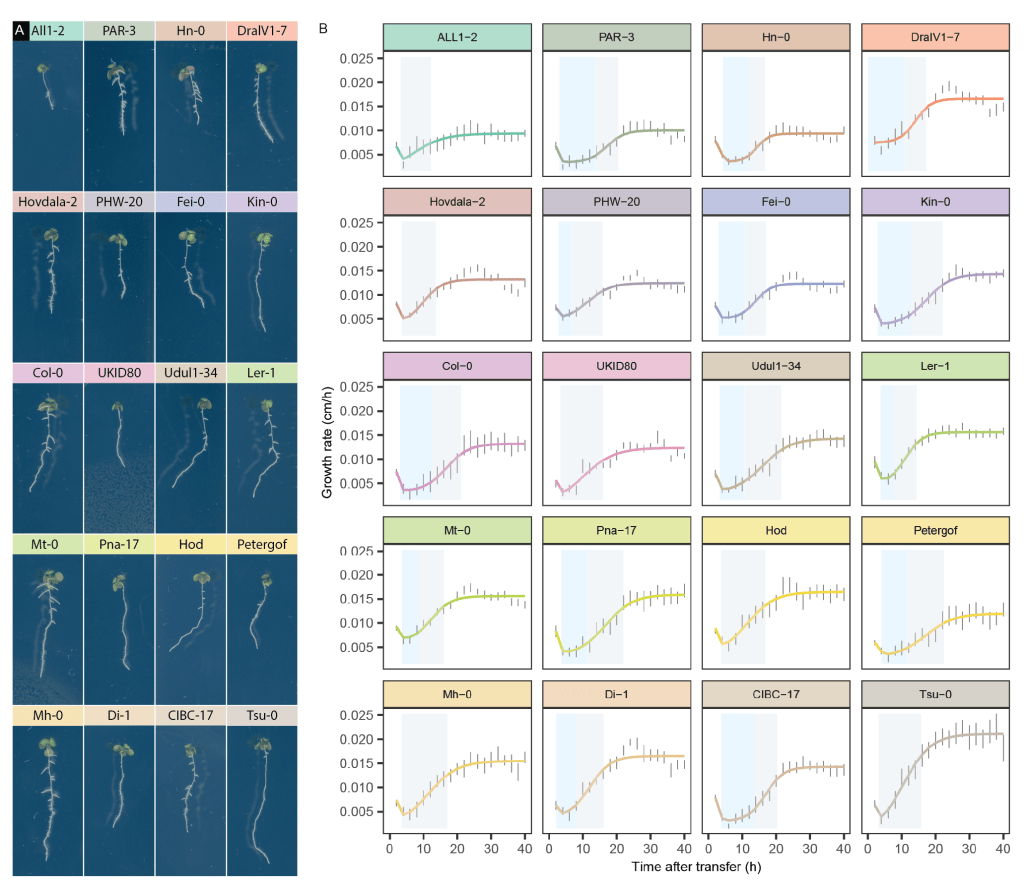
Variation in root architecture and main root growth dynamics in 20 accessions of Arabidopsis. A) Pictures of overall root architecture after salt treatment. B) Root growth dynamics of the main root after salt treatment. The light blue area marks the quiescent phase and the grey area marks the recovery phase.
 Roots in Salt