
Exciting work on the role of abscisic acid (ABA) in regulating root salt stress response, led by our previous PhD and Postdoc Jasper Lamers, has now been published in the PNAS. Please read this interview with Jasper Lamers as he explains how salt induces sodium-specific responses that are later suppressed by ABA (Figure 1 & 2).
This paper also utilises a novel light element profiling technique reported in the work led by our postdoc Parvinderdeep S. Kahlon, currently available on BioRxiv. Sodium detection in plant is crucial for our study in salt stress response, which aims to enhance plant salt stress resilient to combat the crop yield losses due to soil salinisation. By employing monochromatic X-ray fluorescence (XRF) instrumentation and innovative sample preparation, Jasper and the team demonstrated that ABA mutants accumulate more sodium in the Arabidopsis shoot tissues after being exposed to 125mM NaCl for 6 hours compared to wild-type (Col-0) (Figure 1). This novel light element technique can be extended to detect sodium and potassium in rice (Oryza sativa) and Arabidopsis samples as small as 1mg as shown in Parvinderdeep S. Kahlon’s work.
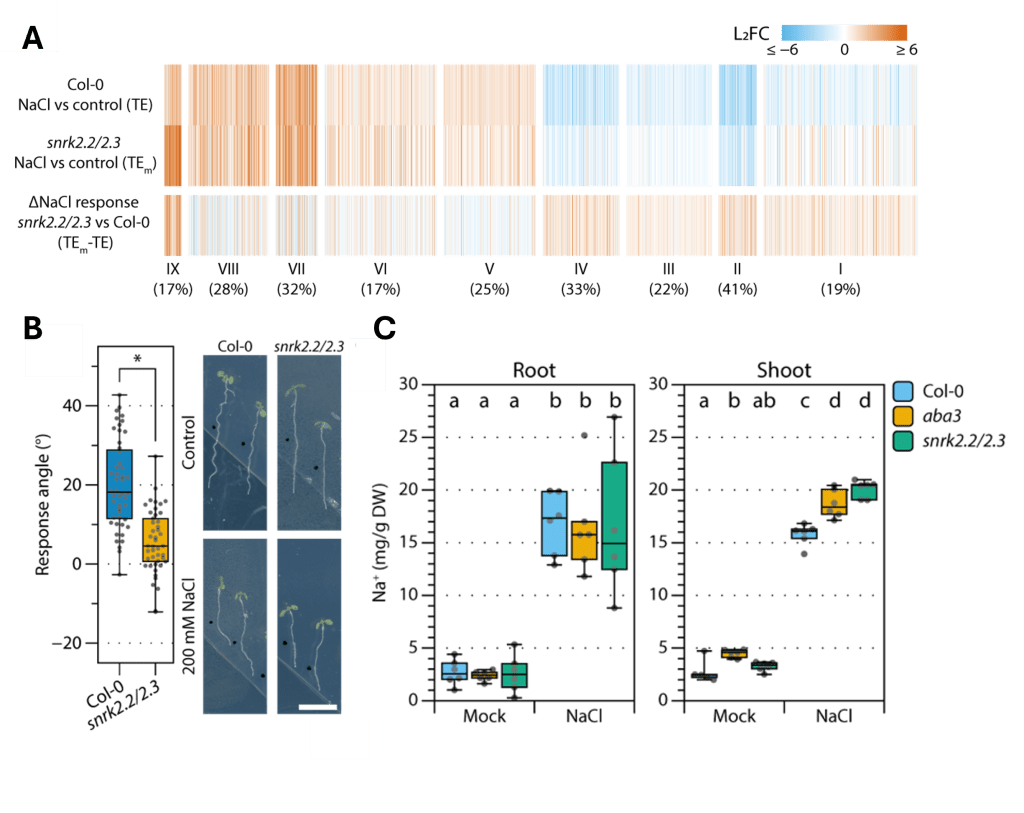
Figure 1. A) Heatmap of the 1,911 overlapping genes from RNA sequencing that were differentially regulated by NaCl in Col-0 and had a differential response in ABA signaling mutants snrk2.2/2.3 compared to Col-0 (FDR < 0.05). The numbers below the cluster number represent the percentage of genes overlapping genes between both RNA sequencing experiments. B) Quantification of the halotropism response of Col-0 and snrk2.2/2.3 at 48 h after the introduction of the NaCl gradient. The response angle shows the difference between control and NaCl conditions for the respective mutant. C)Sodium content in roots and shoots of Col-0, ABA biosynthesis mutant aba3 and snrk2.2/2.3 at 6 h after a 125 mM NaCl treatment.

Figure 2. A model on how acute sodium stress results in cell wall damage, which leads to cell damage in expanding cells in the elongation zone. There is a compelling correlation between damage and sodium-induced gene expression (<1 h). ABA accumulation and signaling is activated at later timepoints (>3 h), which inhibits cell damage and sodium-induced gene expression in a SnRK2.2/2.3-dependent manner. The orange arrow indicates the approximate location of RRTF1 expression, which functions as a marker for sodium-induced gene expression. Solid lines indicate direct evidence. The dashed lines are indirectly supported by our results and literature.
 Roots in Salt