
Introduction
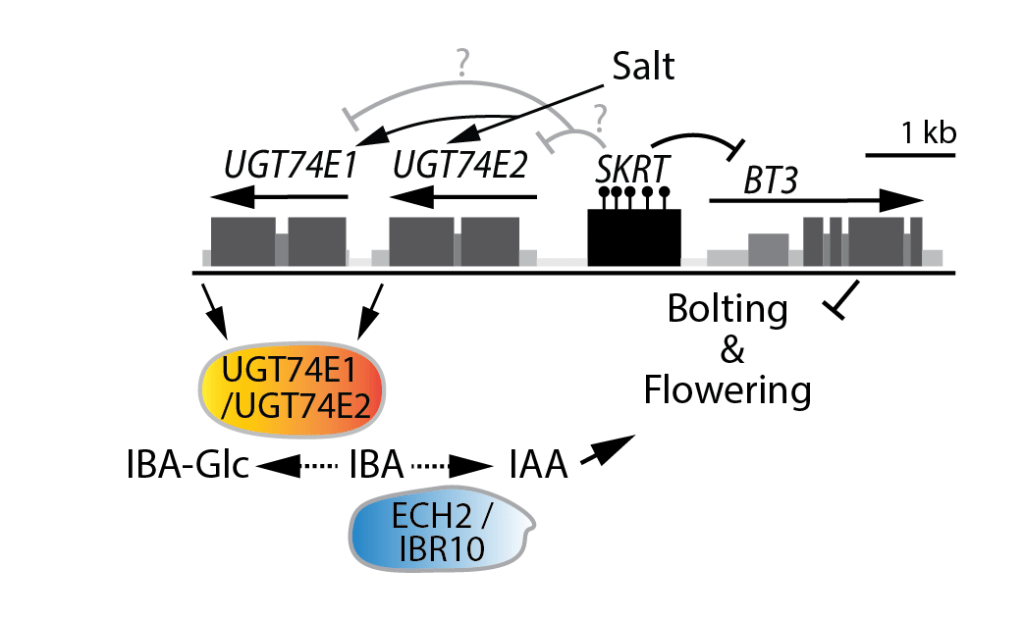
Plants face a multitude of environmental stresses, with salt stress being one of the most elusive. High soil salinity can alter plant development, including the floral transition—the shift from vegetative growth to flowering. However, the molecular mechanisms behind this process remain poorly understood. Our recent study is now available on bioRxiv and it sheds light on a novel regulatory pathway involving the SAUERKRAUT (SKRT) transposon and the adjacent genes: UGT74E1, UGT74E2 & BT3, and their role in controlling the floral transition under salt stress.
Read the Full Study:
🔗 The SAUERKRAUT transposable element accelerates Arabidopsis floral transition
Why Salt Stress Matters
Salt stress is a growing concern in agriculture, especially as climate change intensifies drought conditions. Plants exposed to high salinity often exhibit delayed flowering, which can reduce yield and seed production. Understanding how plants regulate this process at the molecular level is crucial for developing salt-tolerant crops that can thrive in adverse environments.
The Discovery: SKRT and the UUB Locus
Through a genome-wide association study (GWAS) in Arabidopsis thaliana, we identified the UGT74E1-UGT74E2-BT3 (UUB) locus as a key player in regulating bolting time under salt stress. Within this locus, we discovered SKRT, a DNA transposon whose presence and methylation state directly influence flowering time.
- SKRT Deletion and Gene Expression: Deleting SKRT in the Col-0 background led to altered gene expression both within and outside the UUB locus.
- Salt-Dependent Delay: The skrt mutants exhibited a salt-dependent delayed floral transition, indicating SKRT’s role in accelerating flowering under stress.
- IBA Homeostasis Connection: Our data suggest that SKRT’s influence on the floral transition depends on IBA (indole-3-butyric acid) homeostasis, a precursor of the well known auxin indole acetic-acid (IAA) that is critical for plant development.
Implications for Agriculture
The discovery of SKRT’s role in floral transition regulation opens new avenues for crop improvement. By selecting for or deleting transposons or alter the transposon methylation state close to genes that regulate yield or stress resilience, we could potentially develop climate-change proof crops.
Conclusion
Salt stress is a significant challenge for plants, but nature has evolved elegant solutions. Our study highlights the role of SKRT and its methylation in controlling the floral transition, offering a glimpse into the complex interplay between stress responses and development. As we continue to unravel these mechanisms, we move closer to a future where crops can withstand the most adverse conditions.
Read the Full Study:
🔗 The SAUERKRAUT transposable element accelerates Arabidopsis floral transition
Post written by Joram Dongus

