
Small samples, big insights: Rapid elemental profiling using monochromatic XRF
Measuring the elemental composition in plants provides information about how plants respond to environmental cues. Under salinity stress, the maintenance of Na⁺ and K⁺ homeostasis is important for plant growth, survival, and overall fitness. However, reliable, cost-effective profiling of these elements has long been a bottleneck. Conventional methods such as ICP-MS require laborious sample digestion, are expensive, and are not well suited for high-throughput screening. While lower-cost alternatives exist, they often lack the sensitivity required for smaller amounts of plant sample.
In our recently published work in the Journal of Experimental Botany, we present a rapid, cost-effective method for quantitative light element (soduim to calcuim) analysis using monochromatic X-ray fluorescence (MXRF). By combining an optimized sample preparation protocol with the high sensitivity of MXRF, we were able to accurately quantify light elements from plant samples as small as 1 mg, making the technique suitable even for young seedlings and early developmental stages. The measurements showed positive correlations with the ICP-MS while eliminating the need for sample digestion or extraction.
To demonstrate the applicability of the method, we quantified sodium and potassium accumulation in Arabidopsis thaliana, Oryza sativa (rice), and Lactuca sativa (lettuce) exposed to salinity treatments. Beyond sodium and potassium, we also evaluated the accuracy and precision of MXRF for several other light elements, highlighting its versatility for plant ionomics and nutrient profiling.
If you are interested in learning more about the methodology and its applications for plant stress research, you can read the full paper here : Quantitative light element profiling in plant tissues with monochromatic X-ray fluorescence analysis: a new frontier for abiotic stress studies .
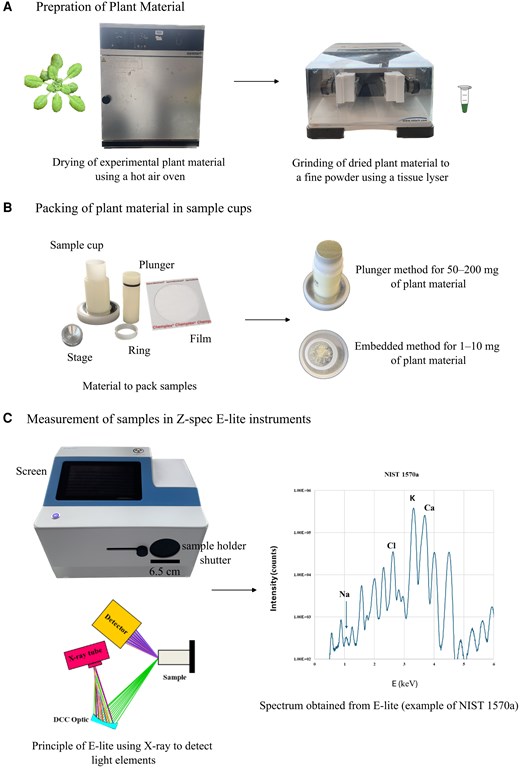
Fig. 1.Schematic representation of the experimental procedure utilized for detecting low-energy elements using the Z-Spec MXRF E-lite instrument. The flowchart outlines the key steps involved in the analysis (A) including sample preparation and (B) packing configurations used for dried plant samples. The plunger method compacts plant material directly into sample cups and is typically used for larger sample masses (5–200 mg; ∼200 mg shown here), whereas the embedded method packs smaller amounts of plant material within a matrix between films (1–50 mg; ∼1 mg shown here), enabling measurements with minimal sample material. (C) MXRF instrument, X-ray excitation, and the resulting data acquisition. The output spectrum is derived from the certified reference material NIST 1570a, highlighting the fluorescence peaks of Na, Cl, K, and Ca.
Post written by Parvinderdeep Kahlon

